| M10 Tank Destroyer (early) | UniModel Kit #201 |
| Article by Doug Chaltry; last updated 2 September 2026 | |
 |
|
| Modeling the Sherman Tank in 1/72nd Scale |
| M10 Tank Destroyer (early) | UniModel Kit #201 |
| Article by Doug Chaltry; last updated 2 September 2026 | |
|
|
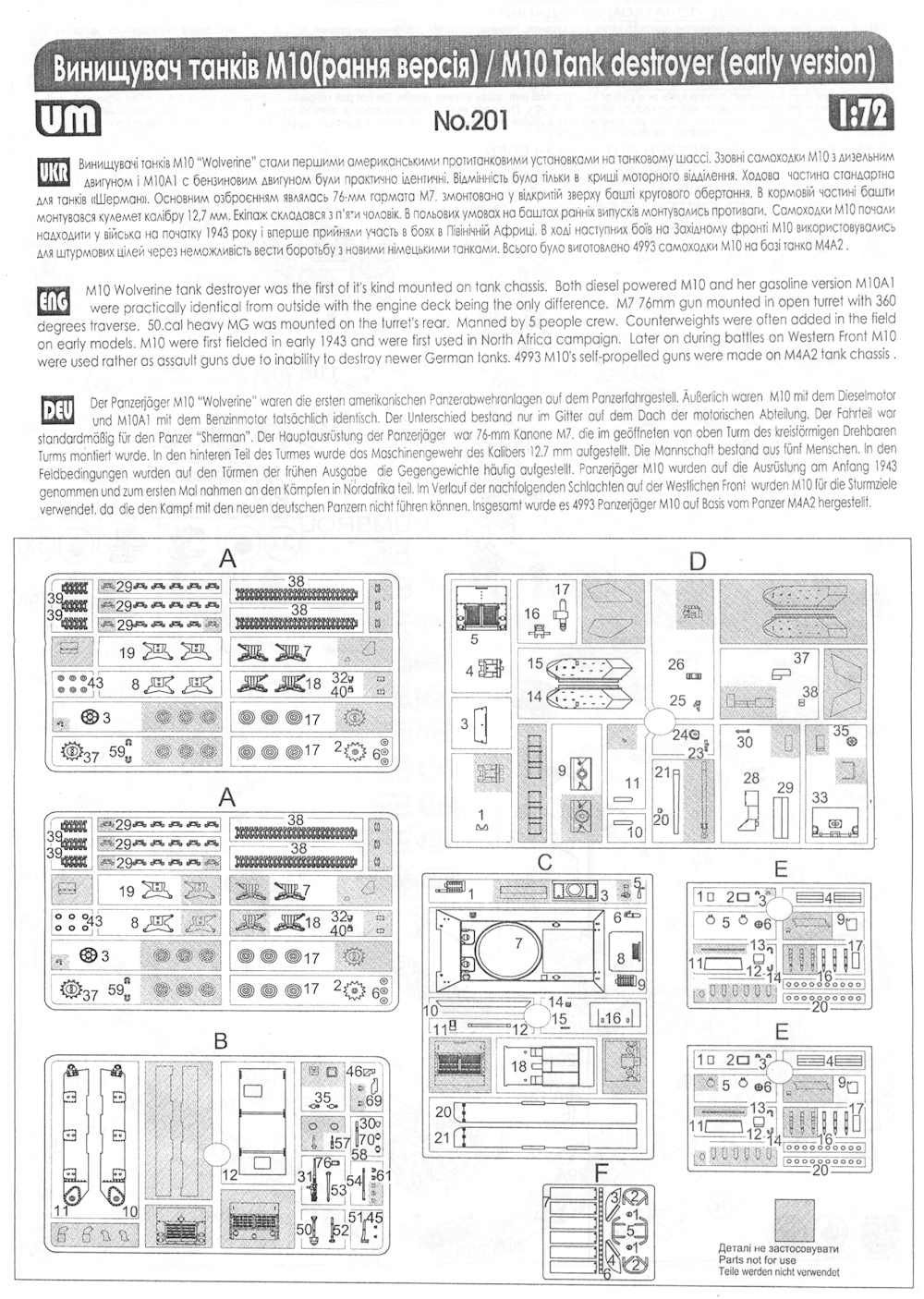
| Most
of this kit is identical to the earlier tank destroyers
that I reviewed from UM, specifically the Achilles and
M36. The first sprue on the left below was first seen in
the M36 kit; it is mostly the same as the Sprue B that
comes with most of UM's Sherman kits, but it has had a
few pieces snipped off prior to packaging, for some
inexplicable reason. That includes the M4A2 engine deck,
which at first I thought was going to be a problem for
this M10 kit, but I see that they included a new engine
deck on a different sprue. The remainder of the sprues in
this first row of scans are the same as was included in
the original Achilles release, and they are fairly decent
as it comes to molding and detail. One exception to that
are some horrendous sink marks along the length of the
fenders, though I think that most all of that will not be
visible once mounted. However, the ends of those sink
marks extend onto the front fenders that will indeed be
visible, so will take some careful filling so as not to
lose the hinge detail. Some other minor sinkmarks seen
elsewhere should be easy enough to fill.
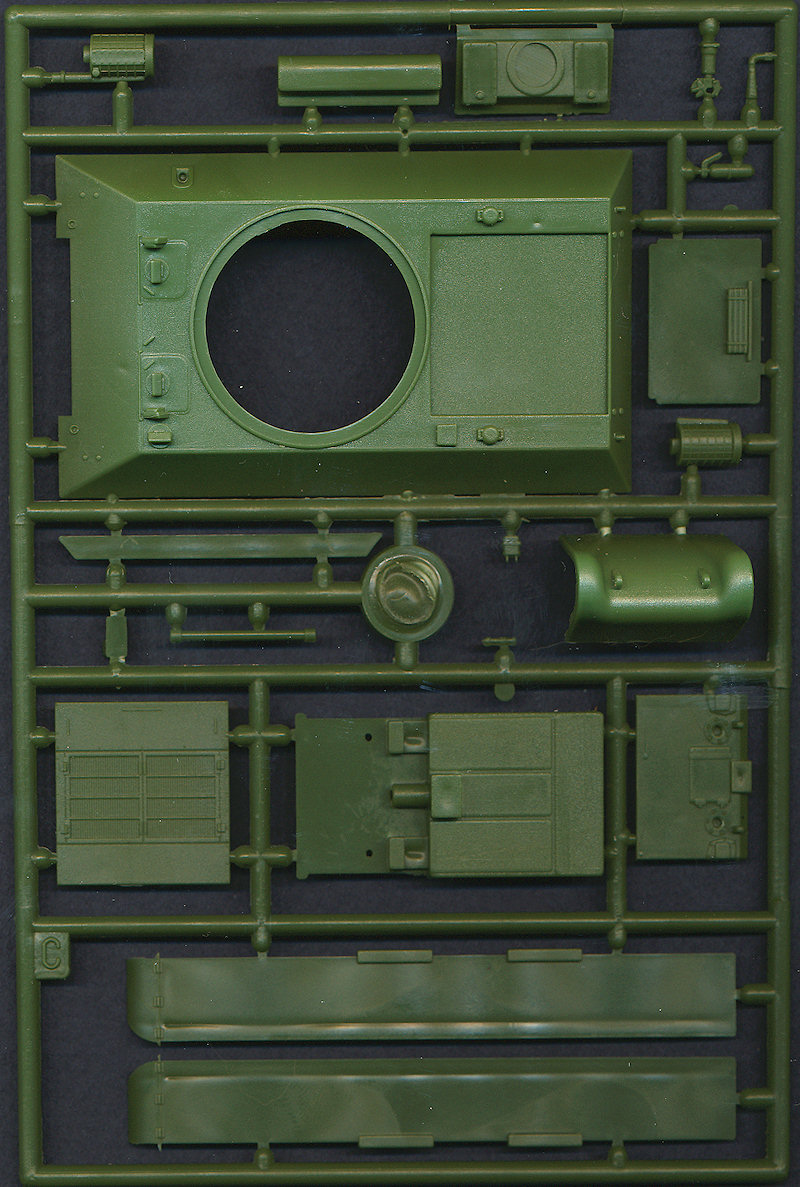
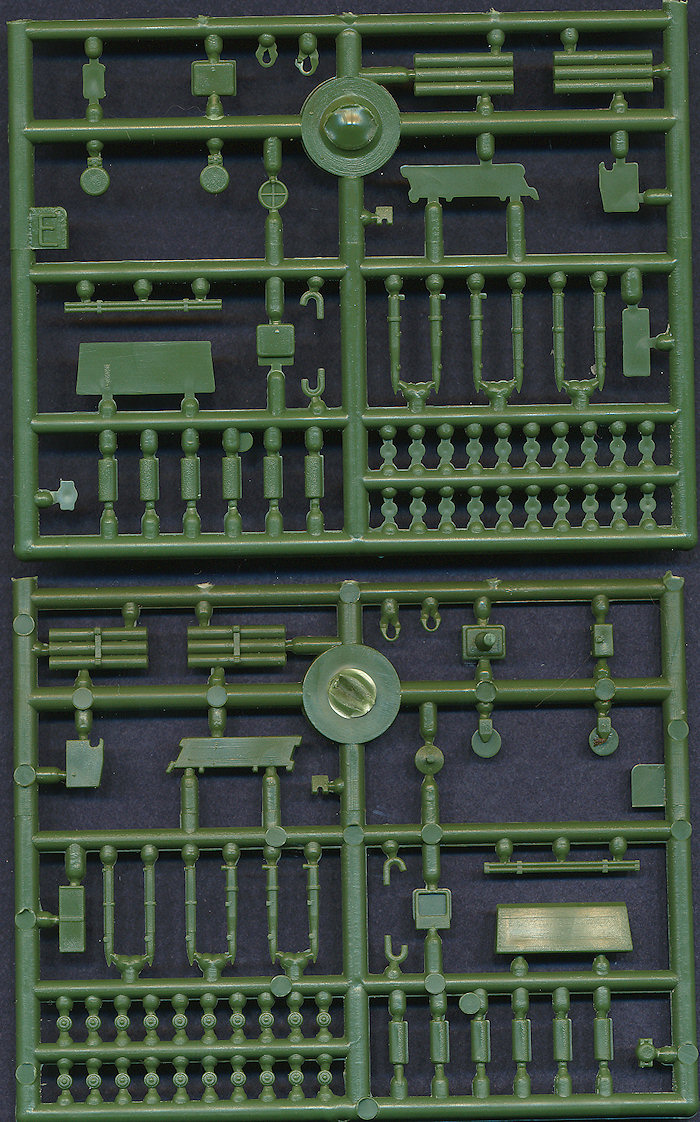
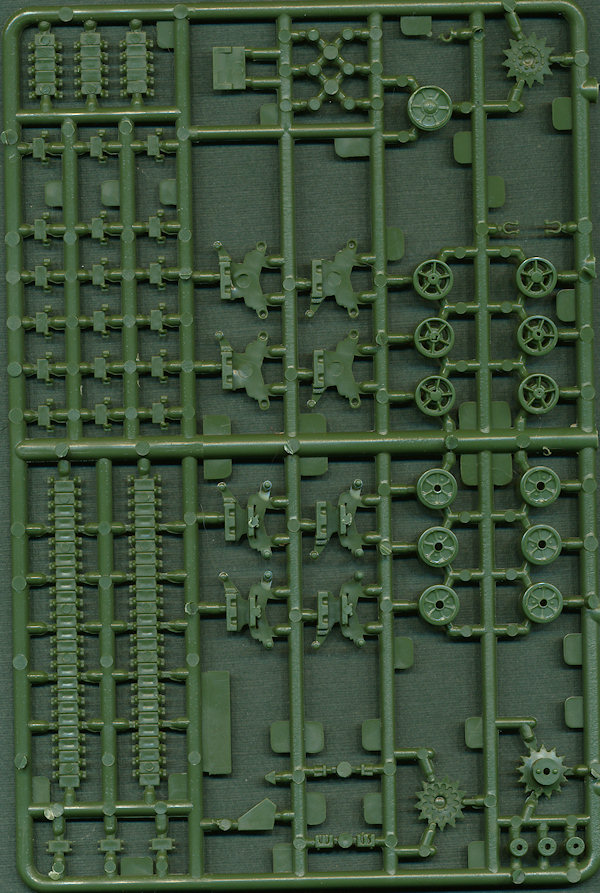
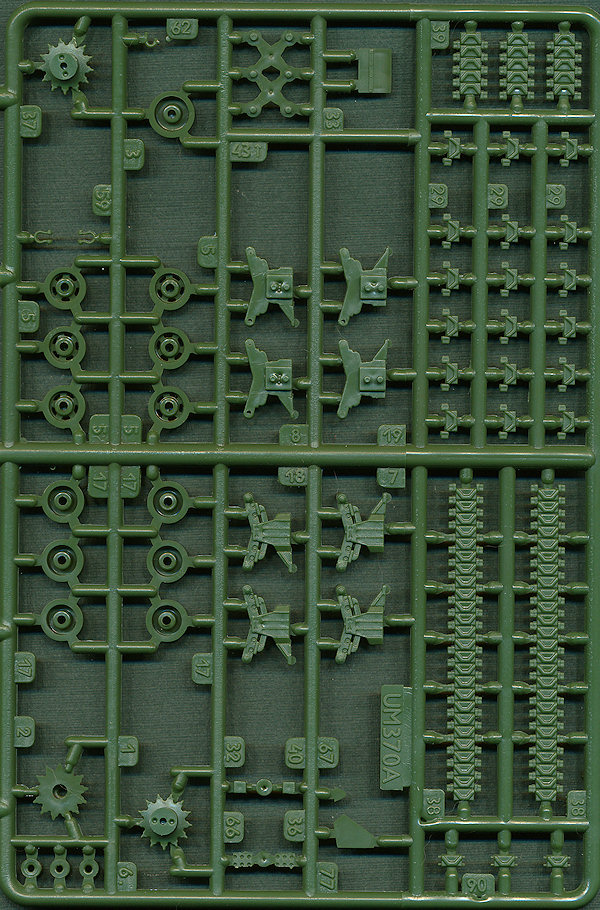
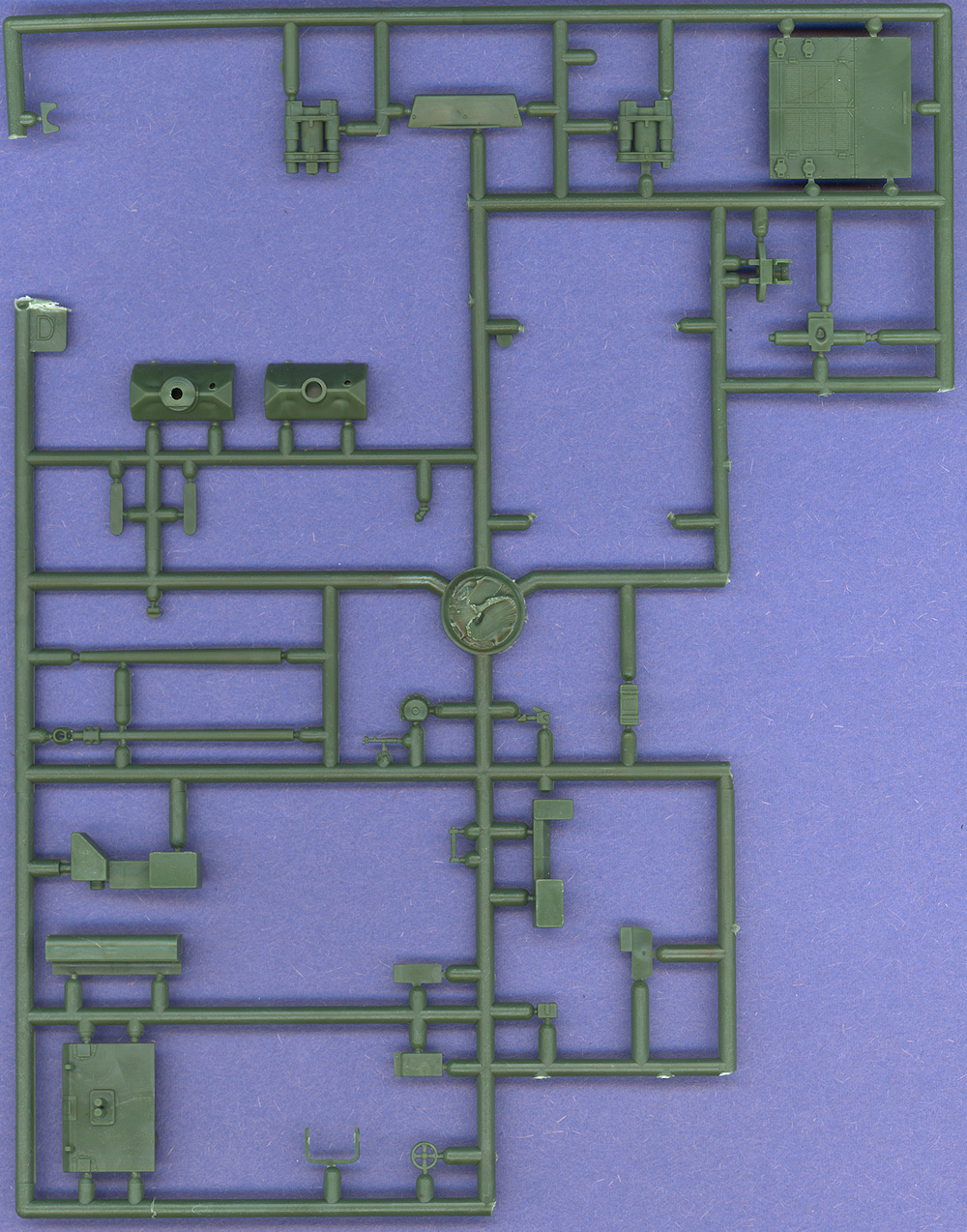
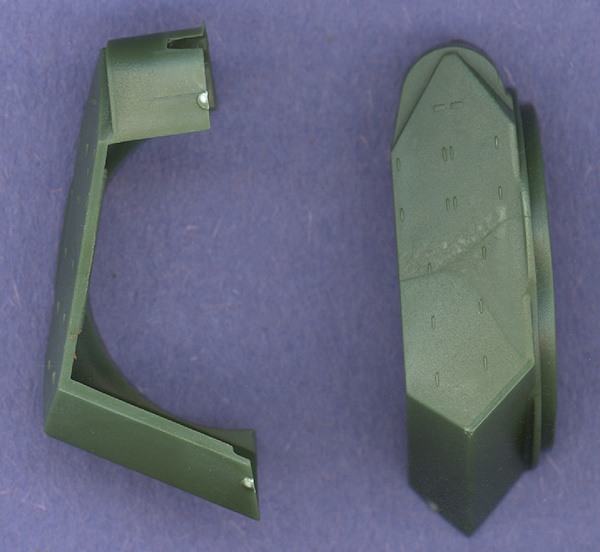
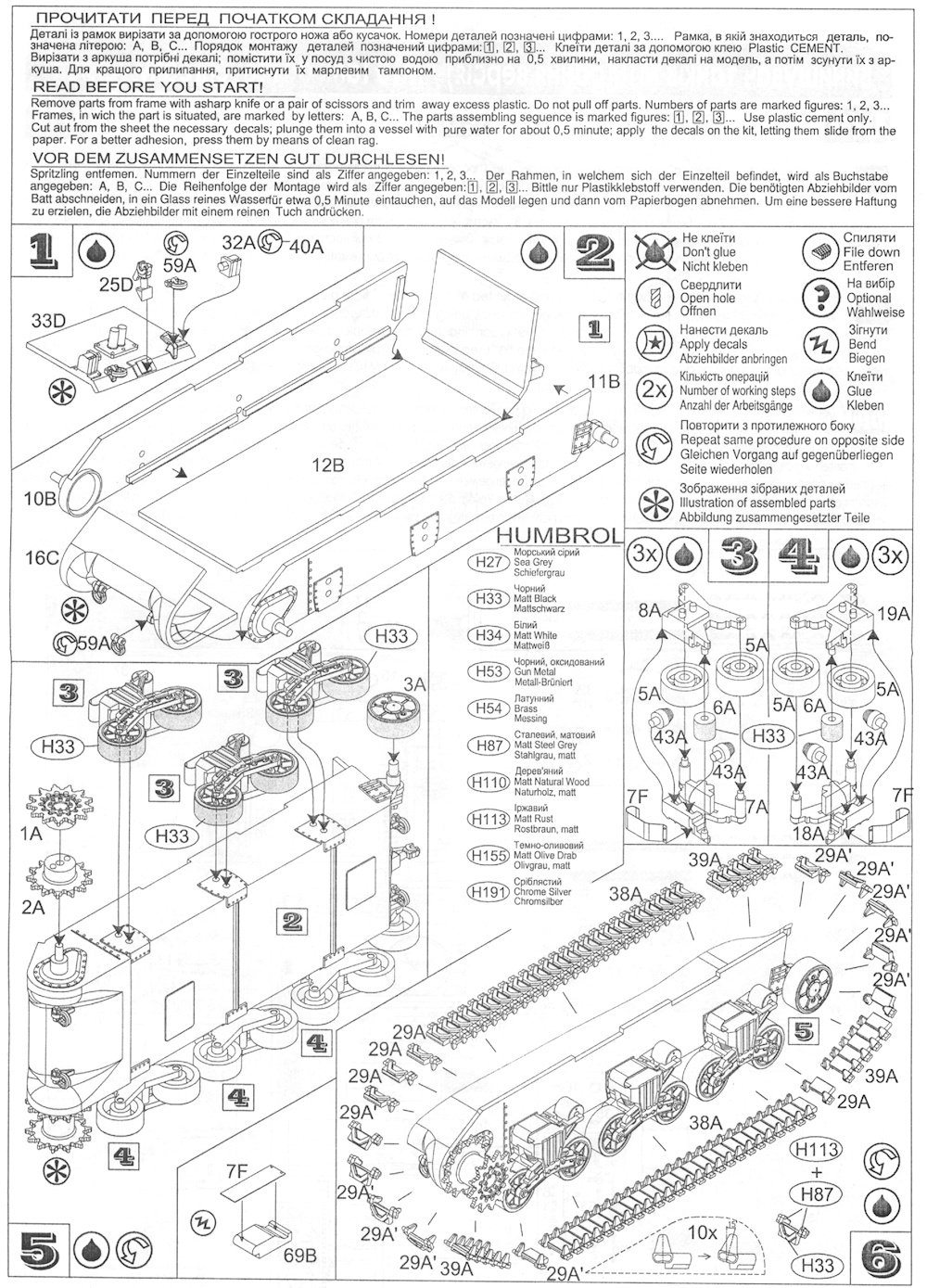
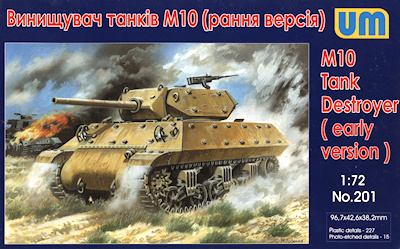
UM has three different wheel/track sprues; the first one was (is?) included in all of UM's initial Sherman releases, and included inaccurate spoked wheels. Once aware of this inaccuracy, UM commendably revised that sprue with newly designed, correct, spoked wheels, and we saw that revised sprue make its appearance with their first tank destroyer kits. (I do not know if reissues of their early Sherman kits still include that incorrect sprue, or one of the later revised sprues.) However, the wheels were not the only weak items on that initial sprue; the rubber chevron T48 tracks also had issues. While the overall width of the tracks (including the end connectors) was accurate, the track blocks themselves were too narrow from end to end, which caused me to express some concern about how they may appear on a built model. Time has passed since I last reviewed these sprues, and I have seen completed UM Sherman models that used the T48 tracks, and my earlier fear that the too narrow track shoes may be a problem has been borne out. They do indeed look very poor on the completed models, leaving noticeable gaps on the insides of the sprocket plates on the drive wheel. At some point UM again revised the wheel/track sprue by replacing the poor T48 tracks with much nicer, and far more accurate, T51 smooth rubber block tracks. But the only kits that I have seen with these newest revised sprues have been the "special releases", those kits that include resin conversion parts to make unusual or rare Sherman variants. This M10 "early" kit includes only the initial revised sprue with the correct wheels, but poor T48 tracks, and thus I highly recommend replacement with spares, if you have them, or aftermarket tracks. It would have been nice if UM had replaced these wheel/track sprues with their "second" revision of the sprue, which was most commonly seen on these vehicles. Hell, even their box art shows the T51 tracks. (Note that I must acknowledge that I do not know when this particular kit that I purchased was manufactured. Was it part of the initial production run prior to UM revising the track sprue a second time? That's entirely possible. It seems that whenever I review kits that have been on the market for awhile, I just assume that it was newly produced, which admittedly is a very poor assumption. It would be great if UM included the newest revision of the track sprue in all current and future production runs, for both new releases and new runs of older kits from their catalogue.) The following scans show the new sprue for this kit (Sprue D). It is similar to the sprue D seen in the Achilles kits, but again, for some reason UM felt the need to clip off most of the spare parts that were used for the Achilles, and are not needed for this early M10 kit. I really think that doing this is a waste of production labor, no matter how insignificant it seems, and results only in depriving the model builder of many spare parts that could be used for other projects. UM isn't the only company that does this, and I really wish I understood the production/marketing philosophy behind doing so, as to me, it just seems cheap. The only parts that are truly unique to this kit are the turret halves.
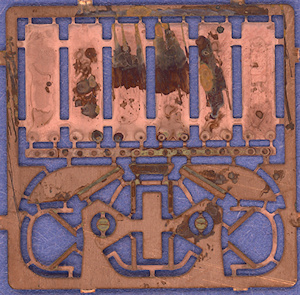
So, what makes this an "Early Version" of the M10? The M10s had a turret balance problem due to the weight of the 3 inch gun barrel; it made traversing the turret rather difficult when the vehicle was on a sloped surface. On the earliest version of the M10, track grousers were stored on the outside of the turret's rear armor plate, which was angled inward, in order to better balance the weight towards the rear of the turret. When this was deemed to be inadequate, "quick-fix" counterweights were mounted on this sloped armor plate instead. These weights were better than the grousers, but still not heavy enough. So they were enlarged into a wedge shape, which worked much better. In the literature on the M10, vehicles with the grousers and/or the flat, rectangular quick-fix weights are referred to as "early production" M10s; those with the wedge-shaped counterweights are termed "mid-production" M10s (UM calls this the "late version"); and the final vehicles with the vertical rear turret wall and the "duck-billed" counterweights are called "late production". This kit includes provision for only the quick-fix counterweights. It would have been nice if UM had included grousers to mount on the turret rear so that we could have modeled the earliest version of the M10, but no grousers are included at all. Nor are the grouser racks included for mounting on the hull sides (they were removed from Sprue D), which is an oversight, because once the grousers were removed from the turret, that was when they were moved to racks on the hull sides. Now we will need to source those parts from somewhere else, or scratchbuild them. As typical of UM kits, etched parts are included. As always, they have included etched track return skids, which is the best way of modeling these parts, in my opinion.
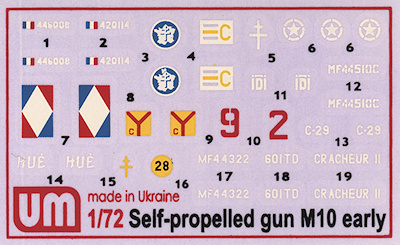
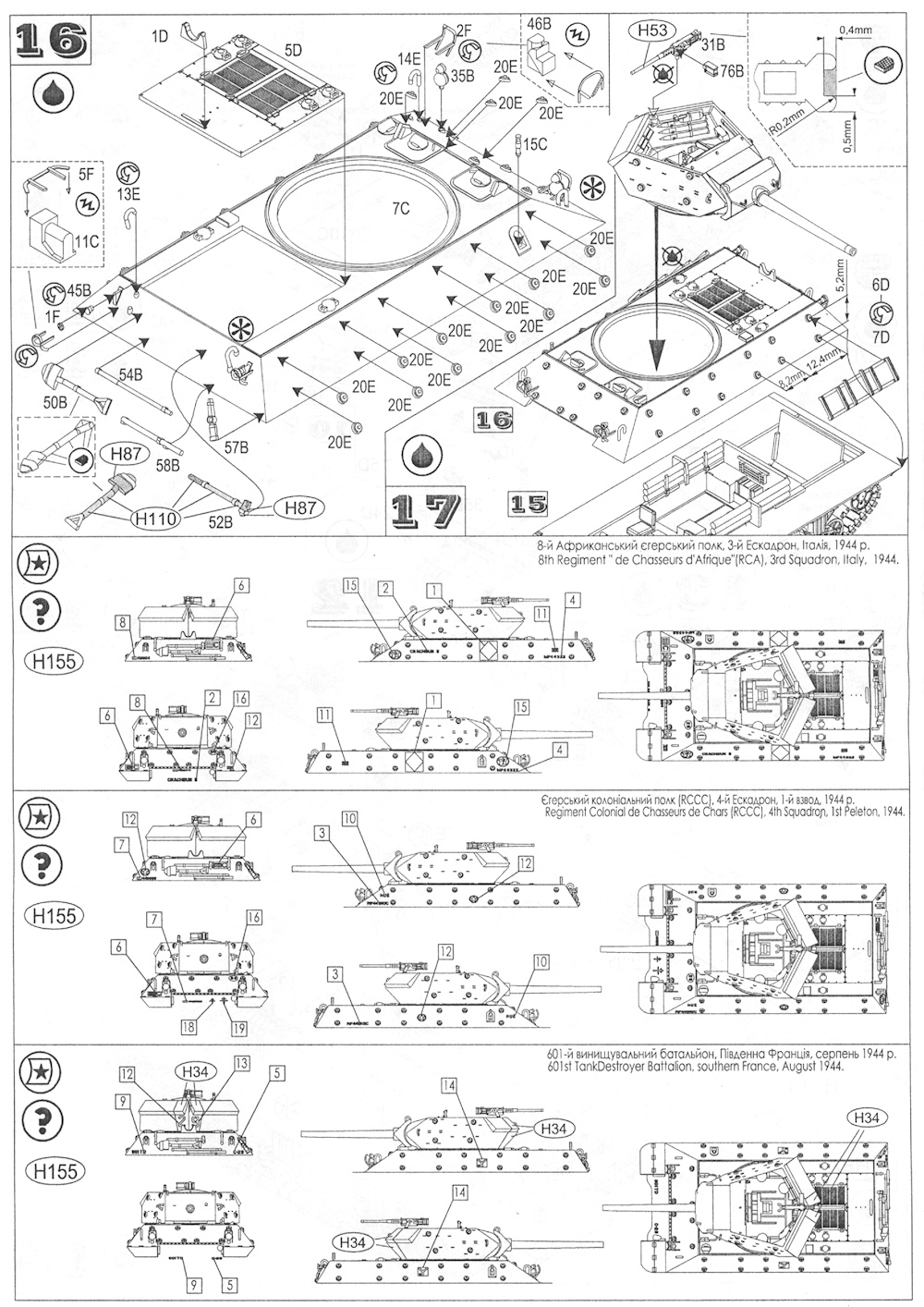
Markings are included for three vehicles, and there are a few issues with them. But first, be aware that the identifying numbers for each decal that are printed on the decal sheet do not match the numbers that the instructions indicate. So we're left with visually identifying which decal goes where by closely examining the drawings in the instructions. 8e Régiment de
Chasseurs d'Afrique, 3rd Squadron, Italy 1944 Note that this tank was equipped with the T51 rubber block tracks, not included in the kit. Also note that there appears to be a fully restored and running M10 in France that bears the name CRACHEUR II, but the markings on that vehicle are very different than what it appears to have worn during the war. Not to mention the fact that the restored vehicle is a mid-production M10 with the wedge-shaped turret counter-weights, not an early version. RCCC Regiment
Colonial de Cuirassuirs de Chars, 4th Squadron, 1st
Platoon, 1944 Note that this tank had T49 (steel bar cleat) tracks, not included in the kit. 601st Tank
Destroyer Battalion, Southern France, 1944
My bottom line for this kit: find yourself some new tracks, and fabricate grouser racks for the hull sides, and it should build into a decent M10. Will need to futz around with the decals a bit as well. |
| Modeling the Sherman Tank in 1/72nd Scale |